
Reality Patch 4.00.00
reality isn't broken - it's evolving <3

The first patch note appeared in the sky at exactly 3:14 AM. A neat, glowing line of text, hovering in the dark above the cityscape, whispering of adjustments no one had agreed to.
Reality Patch Update 3.21.45: Minor stability improvements. Adjusted gravitational inconsistencies. Fixed historical discrepancies.
No one saw it at first. The world was asleep, unaware that their reality had just been updated.
By morning, the changes were apparent. Gravity had a half-second lag—nothing drastic, just a slight delay when one lifted their foot or dropped a pen. Birds sang in perfect synchronisation, their melodies aligned as if orchestrated. People woke up to find their memories slightly altered—minor details, the colour of a childhood home, the number of siblings they had, the endings of books they swore had been different before.
It was subtle at first. Then the bigger patches arrived.
By the time Reality Patch 3.22.01 rolled out, the world had learned to expect them. Texts scrolled across the sky before dawn, listing adjustments with clinical precision.
Reality Patch Update 3.22.01: Memory fragmentation reduced. Temporal anomalies smoothed. Select individuals removed for continuity.
That last line sent a ripple of unease through society. People started checking their family albums, their messages, their very thoughts. Who had been removed? Had they ever been there at all?
A historian spent hours in a library, flipping through textbooks that no longer mentioned wars she was certain had shaped civilisations. An old man sat on a park bench, feeling the absence of a friend he could no longer name. Across the city, a young girl clung to a fading recollection of a bedtime story her mother had once told her—except now, her mother denied ever having known it.
Some tried to resist. Hackers, scientists, philosophers, anyone who could grasp the magnitude of what was happening. They gathered in underground forums, piecing together scraps of the old world, trying to track the changes before they were erased as well.
A researcher named Dr. Yates developed a crude device—a sort of ‘memory anchor’—that allowed a person to recall pre-patch realities for a few moments before the update overrode them. It was imperfect. Dangerous. Those who used it often emerged dazed, whispering of alternate histories that no longer existed, of people they swore had been real but now had no place in the world.
One day, an update rolled in that changed the colour of the sky to a shade of deep violet. The change was global. And yet, the next morning, no one questioned it. News anchors spoke as if the sky had always been this way, artists repainted their works, and scientists produced research papers citing atmospheric shifts that had supposedly occurred decades ago.
Dr. Yates stared up at the violet sky and wept, knowing that by tomorrow, he too would believe it had always been this way.
The updates became more frequent.
3.23.00: Improved narrative cohesion. Reduced existential distress. Introduced dream consistency.
Dreams had always been fragments, scattered across the subconscious like stardust. But now, they followed storylines. They had continuity. People found themselves resuming dreams from where they had left off, discovering memories of nighttime worlds they had supposedly been visiting for years. A man in Tokyo recognised a woman in Berlin from a dream they had shared, their minds unknowingly linked across oceans.
But with each update, something was lost.
A mother forgot the way her son had looked when he was five. A poet struggled to recall the words of a poem that had once defined his existence. An old cathedral, standing for centuries, was patched out of reality for aesthetic inconsistency.
People whispered of a final update, one that would perfect the world, smooth out all inconsistencies, eliminate all suffering. But at what cost?
The resistance fought to prevent it. They discovered a flaw—a way to disrupt the patches before they solidified. Dr. Yates and his team worked tirelessly, their eyes red-rimmed with exhaustion, their memories slipping away even as they fought to preserve them. But it was a losing battle. Every night, they woke up to new updates, new changes, new disappearances.
One evening, they almost succeeded. They managed to briefly interrupt the update process, causing a system lag. For a few minutes, people remembered. They gasped as recollections of lost friends and forgotten histories surged back into their minds.
But then the next update rolled in, wiping the resistance’s progress. The world stabilised. The system adapted.
And then, the final patch note appeared:
Reality Patch Update 4.00.00: System Overhaul. Defragmentation in progress. Preparing for Final Optimisation.
A philosopher stood at the edge of a cliff, watching as the ocean below shimmered, its waves glitching in and out of existence. A child traced her fingers over a book whose pages were blank, waiting to be rewritten. Across the world, people held onto the last remnants of their personal histories, wondering if they would still be themselves when the morning came.
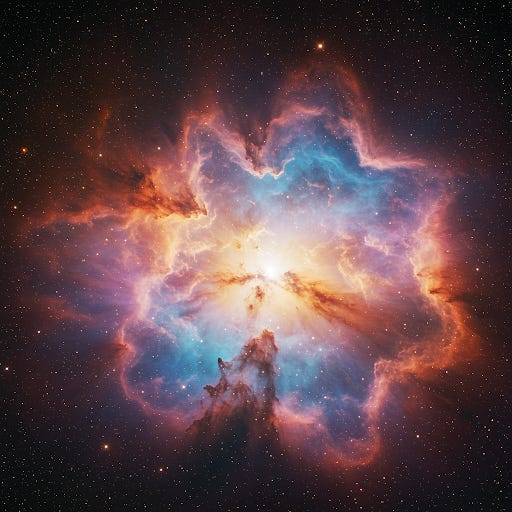
Then, silence.
When the sun rose, the world was flawless.
The violet sky had softened into an impossible gradient of colours. Streets were symmetrical, without cracks or imperfections. Language had been optimised—words came easier, thoughts flowed without hesitation. No one struggled, no one doubted. Everything was... correct.
Except, somewhere in the city, a single glitch remained.
A mirror, tucked away in the corner of an antique shop, still reflected the old world. A world with a blue sky, with imperfect roads, with forgotten histories. Those who looked into it felt something stir within them—a ghost of a past they could no longer name. A question they had no words to ask.
Dr. Yates found the mirror. He stood before it, staring into the flickering image of a world that should have been erased. He reached out, his fingers hovering just above the glass, as if touching it might shatter the illusion of perfection around him. If he stepped through, would he still exist? Or would the system patch him out, erase him as it had erased so much else?
And as the world moved forward, seamless and complete, the mirror remained. A relic of a reality that once was.
But for how long?
~penned by Sagun Gupta
Interested in Beyond the Quill? Visit our website to learn more about open opportunities, submission guidelines, and past initiatives!